



A bocce ball court is more than just a recreational space; it is a carefully designed playing surface that blends precision, tradition, and engineering. Originating from ancient Roman games and refined in Italy, bocce has become a popular outdoor sport across the world. The court plays a crucial role in how the game is experienced, as even the smallest variation in surface quality or dimensions can influence the roll of the ball. A well-built bocce ball court ensures fairness, consistency, and enjoyment for both casual players and competitive athletes, making it an essential part of the game’s structure.
What is a Bocce Ball Court
A bocce ball court is a long, narrow, and flat playing area enclosed by sideboards that keep the balls in play. The main objective of the game is to roll larger balls as close as possible to a smaller target ball known as the pallino. The court is specifically engineered to provide a smooth and predictable surface so that skill rather than luck determines the outcome. While professional courts follow strict guidelines, backyard versions can be customised based on available space without losing the essence of the game.
Standard Dimensions and Layout
The dimensions of a bocce ball court depend on its purpose. Official tournament courts are typically around 13 feet wide and up to 91 feet long, ensuring ample space for strategic play and long-distance rolling. Residential courts, however, are often scaled down to fit gardens or recreational areas, usually ranging between 10 and 12 feet in width and 50 and 76 feet in length. The layout is designed in a rectangular shape with clearly defined boundaries and levelled ground to maintain consistent ball movement. Proper spacing ensures that players have enough room to execute different throwing techniques, including pointing and hitting shots.
Construction Layers of a Bocce Ball Court
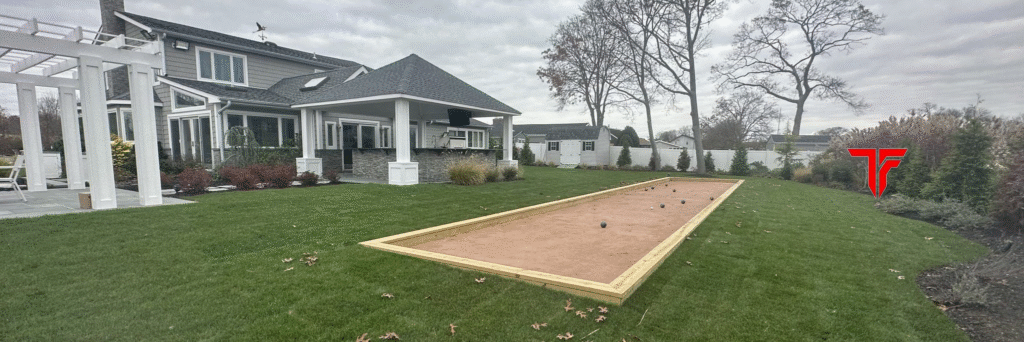
Building a durable bocce ball court requires careful attention to its foundation. The structure typically consists of multiple layers that work together to provide stability and drainage. The sub-base layer consists of tightly compacted crushed stone, providing a stable foundation that stops ground movement and enhances long-term strength. Above it lies the drainage layer, which includes finer gravel and landscape fabric to allow water to pass through while blocking weed growth.
The top layer is the playing surface, which determines the speed and feel of the game. A properly constructed court ensures smooth ball movement, minimal maintenance issues, and long-lasting performance even under varying weather conditions.
Surface Materials and Their Impact
The choice of surface material significantly influences how a bocce ball court performs. Traditional courts often use crushed oyster shells, which provide an authentic texture and moderate ball speed, although they require regular raking to maintain consistency. Decomposed granite or stone dust is another popular option, offering a firm and compact playing surface that is cost-effective and relatively easy to maintain. Modern installations sometimes use synthetic turf, which delivers a uniform roll and excellent weather resistance with minimal upkeep. Each material offers a unique playing experience, allowing builders to select based on budget, maintenance preference, and desired game style.
Rules and Boundary Markings
Clear markings are essential for fair play on a bocce ball court. The centre line divides the court into two halves and helps determine valid throws. The foul line is another important boundary that players must not cross when releasing the ball, ensuring consistency in gameplay. Some courts also include specific lines for different types of shots, such as pointing or hitting, which adds strategic depth to the game. Sideboards or bumpers are installed along the edges to prevent balls from leaving the court and to introduce rebound strategies that skilled players can use to their advantage.
Backyard Design Considerations
Designing a backyard bocce ball court requires balancing available space, budget, and intended use. Homeowners often adjust standard dimensions to fit their outdoor areas while maintaining proportional width and length for proper gameplay. Drainage is a critical factor, especially in regions with heavy rainfall, as poor water management can damage the surface over time. Proper levelling of the ground is also essential to prevent uneven ball rolls. Many homeowners choose decorative elements such as wooden borders or landscaped surroundings to make the court both functional and visually appealing, turning it into a social and recreational centrepiece.
Maintenance and Longevity
Regular maintenance ensures that a bocce ball court remains in excellent condition for years. This includes raking the surface to maintain smoothness, checking for uneven areas, and ensuring proper drainage after rainfall. Over time, natural surfaces such as crushed stone or oyster shells can settle or move slightly, so occasional re-levelling is needed to keep the court even. Synthetic surfaces require less maintenance but still need occasional cleaning to remove debris. Proper care not only extends the life of the court but also ensures consistent gameplay, which is essential for both casual matches and competitive games.
Benefits of a Bocce Ball Court
A well-designed bocce ball court offers numerous benefits beyond recreation. It promotes physical activity, encourages social interaction, and provides a low-impact sport suitable for all age groups. The game helps improve hand-eye coordination, strategic thinking, and concentration. Additionally, having a dedicated court at home enhances property value and creates a unique outdoor entertainment space. Whether used for family gatherings or friendly competitions, a bocce court brings people together in a relaxed and engaging environment.
Conclusion
A bocce ball court is a blend of tradition, engineering, and recreational design that transforms a simple game into a structured and enjoyable experience. From its layered construction and carefully chosen materials to its precise dimensions and thoughtful design, every aspect contributes to the quality of play. Whether built for professional use or backyard enjoyment, a well-planned court ensures long-lasting performance and endless entertainment. Understanding its structure and maintenance needs allows anyone to create a space that celebrates both sport and social connection.
FAQs
1. What is the ideal size for a backyard bocce ball court?
A typical backyard bocce ball court ranges from 10 to 12 feet wide and 50 to 76 feet long, depending on available space and user preference.
2. What materials are best for building a bocce court surface?
Common materials include crushed oyster shells, decomposed granite, stone dust, and synthetic turf, each offering different playing speeds and maintenance levels.
3. How long does it take to build a bocce ball court?
Construction time varies, but a standard residential bocce ball court can take anywhere from a few days to a couple of weeks, depending on design complexity.
4. Does a bocce court require a lot of maintenance?
Maintenance is generally low but includes occasional raking, levelling, and cleaning to ensure a smooth and consistent playing surface.
5. Can a bocce ball court be built on any type of ground?
Yes, but the ground must be properly levelled and prepared with a stable base and drainage system to ensure long-term durability and proper gameplay.
READ MORE: thefundly
