



The rapid growth of artificial intelligence (AI), machine learning, and cloud computing has created unprecedented demand for high-speed network connectivity. As modern data centres scale to support larger workloads and increasingly complex architectures, network operators require solutions that deliver higher bandwidth, lower latency, and greater efficiency. Among the latest advancements in optical networking, 400G QSFP112 modules have emerged as a key technology for enabling next-generation AI and cloud infrastructures.
These optical transceivers are designed to support 400Gbps Ethernet transmission while maintaining high port density and power efficiency. Leveraging PAM4 modulation and advanced optical technologies, 400G QSFP112 FR4 modules provide reliable long-reach connectivity over single-mode fibre, making them well-suited for data centre interconnects, leaf-spine architectures, and AI cluster networking.
As enterprises and cloud service providers continue upgrading from 100G and 200G networks, understanding the capabilities and deployment advantages of 400G QSFP112 FR4 transceivers becomes increasingly important. This article explores their key features, working principles, and applications in modern AI and cloud environments.
What Is a 400G QSFP112 FR4 Optical Module?
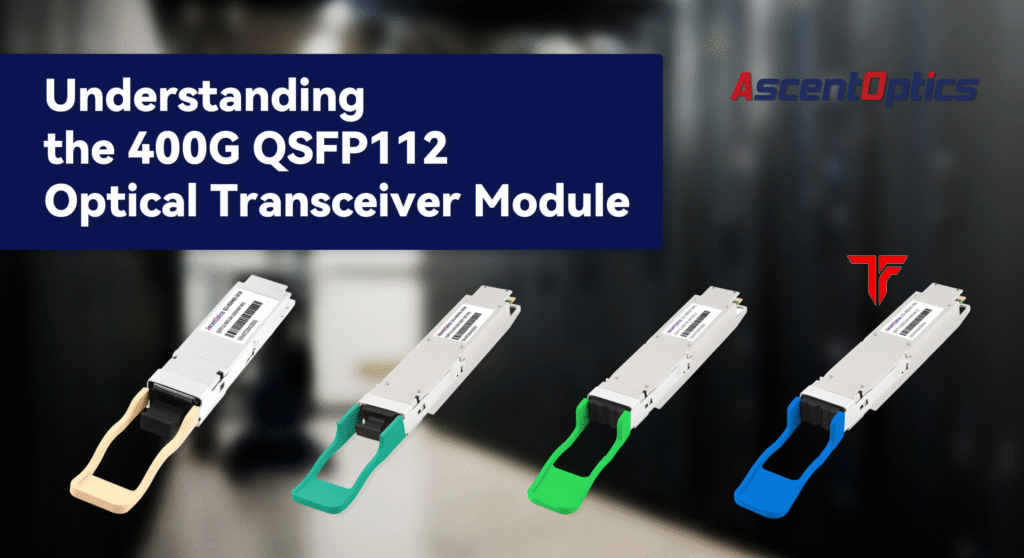
A 400G QSFP112 FR4 optical transceiver is a high-speed pluggable module that complies with the 400GBASE-FR4 Ethernet standard. It utilises the QSFP112 form factor, which features four electrical lanes operating at 100Gbps PAM4 modulation, delivering an aggregate bandwidth of 400Gbps.
The “FR4” designation refers to a 400G optical interface capable of transmitting data up to 2 kilometres over duplex single-mode fibre. Unlike parallel optics solutions that require multiple fibre pairs, FR4 technology employs wavelength division multiplexing (WDM) to combine four optical wavelengths onto a single pair of fibres. This significantly reduces fibre consumption while simplifying cabling infrastructure.
Typically operating at wavelengths around 1310nm, FR4 modules use duplex LC connectors and support Digital Diagnostic Monitoring (DDM), allowing administrators to monitor parameters such as temperature, voltage, laser bias current, and optical power levels in real time.
Benefits of 400G QSFP112 FR4 Modules
Higher Bandwidth for AI Workloads
AI training clusters and large language model deployments require enormous east-west traffic between GPUs, storage platforms, and networking equipment. The 400Gbps bandwidth provided by QSFP112 FR4 modules helps eliminate bottlenecks and ensures efficient data movement throughout the network.
As AI infrastructure continues to scale, higher-speed optical connectivity becomes essential for maintaining application performance and minimising training times.
Efficient Fibre Utilisation
Compared with parallel optics solutions such as 400G DR4, FR4 modules require only two fibres instead of eight. This reduction in fibre count simplifies cable management and lowers infrastructure costs, particularly in hyperscale environments with thousands of optical links.
The use of standard duplex LC connectors also allows organisations to leverage existing fibre infrastructure more effectively.
Extended Reach Capability
With support for transmission distances up to 2 kilometres, 400G FR4 modules provide greater flexibility than short-reach alternatives. They can connect switches located in different rows, halls, or buildings within a campus environment while maintaining full 400G performance.
This extended reach makes them suitable for both intra-data centre and data centre interconnect applications.
Applications in AI and Cloud Networks
AI Cluster Networking
Modern AI clusters consist of hundreds or even thousands of GPUs interconnected through high-speed networking fabrics. These environments demand low-latency, high-bandwidth communication to support distributed training and inference workloads.
400G QSFP112 FR4 modules provide the connectivity required between leaf and spine switches, enabling efficient data exchange across the cluster and helping maximise GPU utilisation.
Cloud Data Centres
Cloud service providers continuously expand their infrastructure to accommodate growing customer demand. As server densities increase, traditional 100G and 200G links may no longer provide sufficient capacity.
By deploying 400G FR4 optics, cloud operators can significantly increase network bandwidth without dramatically increasing rack space or power consumption. This helps support large-scale virtualisation, cloud storage, and high-performance computing applications.
Data Centre Interconnects
Many enterprises operate multiple data centres within a metropolitan area or campus environment. The 2km reach of FR4 modules enables high-speed connections between facilities while preserving a simple duplex fibre architecture.
This capability supports workload migration, disaster recovery, and distributed computing strategies that require reliable inter-site connectivity.
Choosing the Right 400G QSFP112 FR4 Module
When selecting a 400G QSFP112 FR4 transceiver, network designers should evaluate compatibility, transmission distance, power consumption, and monitoring capabilities. Modules designed for NVIDIA/Mellanox platforms can provide seamless interoperability with supported switches and networking equipment, helping ensure stable performance in demanding environments.
Organisations should also consider future scalability. As AI workloads continue growing and networks evolve toward 800G and beyond, deploying standards-based 400G optics today can create a strong foundation for future upgrades.
Conclusion
The rise of AI and cloud computing is driving the adoption of faster and more efficient networking technologies. 400G QSFP112 FR4 optical modules combine high bandwidth, PAM4 modulation, wavelength multiplexing, and duplex LC connectivity to deliver reliable 400Gbps transmission over distances up to 2 kilometres.
For AI clusters, hyperscale cloud data centres, and enterprise networks seeking to balance performance, scalability, and cost efficiency, 400G QSFP112 FR4 transceivers represent a practical and future-ready solution. As demand for high-speed connectivity continues to grow, these modules will play an increasingly important role in supporting next-generation digital infrastructure.
READ MORE: thefundly
